AI search vs SEO: what is changing and what is not
What Google says about AI Overviews and AI Mode, what studies show about clicks and citations, and what stays the same for SEO. Sources and limits shown.
14 min read
 Published by Waqas Nasir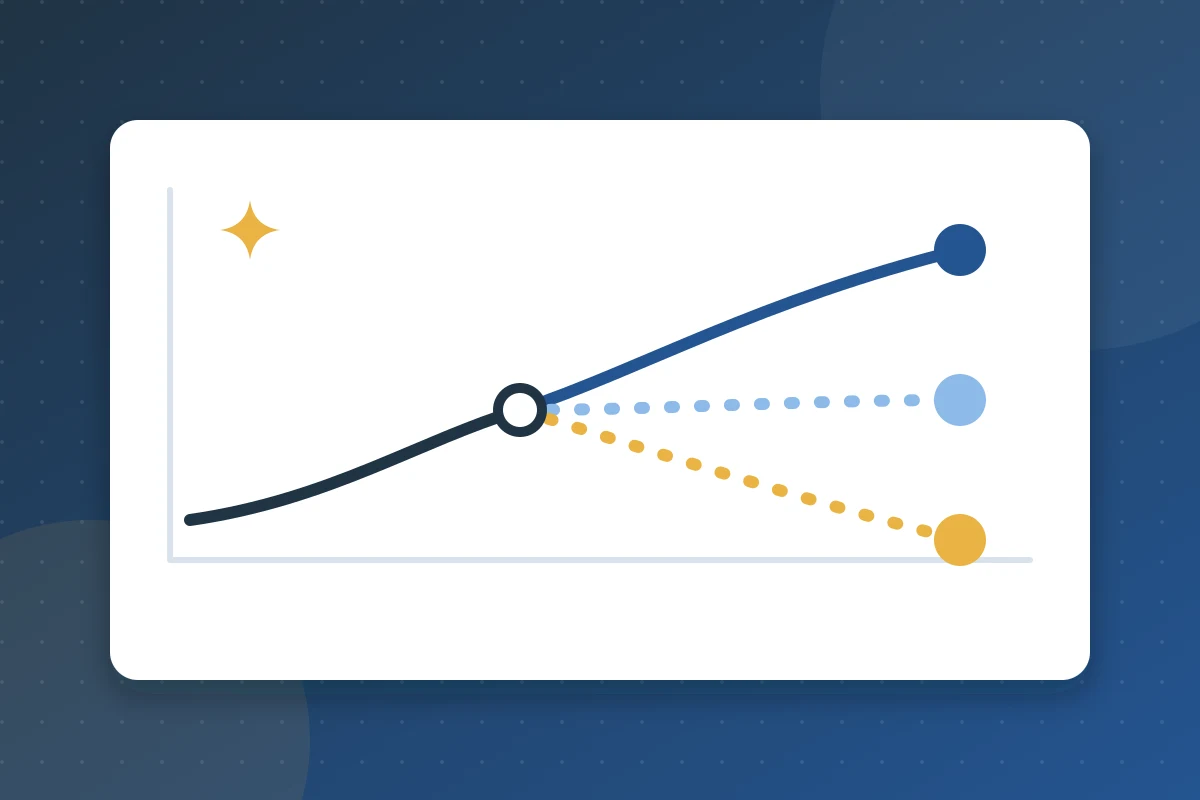
Will AI replace SEO? We don't think so, but we do think parts of it will change. This post is our forecast for the next two to three years. It is opinion, so every prediction is labeled as ours, with the reason, the facts it leans on and what would prove us wrong. The facts themselves, with their methods and limits, are in AI search vs SEO: what is changing and what is not. Read that first if you want the evidence behind the numbers we cite here.
We expect fewer clicks on answer-style searches, classic search staying underneath AI answers, unstable AI citations, and real links and mentions on real sites keeping their value while cheap ones lose it. We could be wrong on each, and we say how you'd find out.
Predictions are only as good as what they rest on, so here is the short list. Each one has its method in the companion post.
Two things to keep in mind. Many of these figures come from one or two vendors that sell AI-visibility tools, and the data changes fast. Ahrefs's own measure of how often AI Overview citations also ranked in the top 10 dropped from about 76% to 37.9% in under a year.
Our view: Over the next two to three years, informational searches that an AI answer can resolve, such as "what is," "how do I" and "why does," will send fewer clicks to websites than they did in 2023. We're most confident about this one.
Why: Three independent measurements point the same way. Pew's sample, Ahrefs's Search Console data and Seer Interactive's data all show lower click-through when an AI answer is present. The searches that trigger answers most often are the long, question-style ones: in Pew's sample, 53% of searches with ten words or more got an AI summary, against 8% of one- or two-word searches. Those are also the searches informational content is written for.
What would prove us wrong: A few quarters of Search Console–based data showing click-through on queries with AI answers rising back toward the level of queries without them. Or Google publishing site-level numbers, not just the statement that total organic click volume is "relatively stable," that show clicks to sites growing. Neither has happened as of October 2026. Note that Seer also found click-through falling on queries without an AI Overview, so AI isn't the only thing moving it.
Our view: AI answers will sit on top of search for the next two to three years. They won't replace it.
Why: Google says its AI features are built on its core ranking systems, and it uses those systems to retrieve the pages that ground each answer. People haven't left search either. A SparkToro analysis of Datos panel data (published August 2025) found that 95% of Americans still use traditional search each month, and that the share of heavy search users went from 84% in early 2023 to 87% in early 2025, even as heavy AI use climbed above 20%. AI chat is also a small referral source: 0.25% of site traffic on average in Ahrefs's June 2025 sample, with Google sending about 210 times more traffic than the three biggest AI platforms combined. Alphabet reported Search and other revenue of $63.271 billion for the second quarter of 2026, up 17%, and said AI features are driving query growth.
What would prove us wrong: Panel data showing search use falling among heavy AI users. A sharp rise in AI referrals, well beyond the low single digits, across a large sample of sites. Or Google's own reporting showing that Search growth has stalled. Revenue is a weak signal here, because it doesn't tell us what happens to publishers, so we'd watch usage data first. The Datos panel also misses mobile app use, which is a real gap.
Our view: Expect AI answers to keep changing which sources they cite, and expect any tool that reports one fixed "AI ranking position" to stay unreliable.
Why: The measured instability is large. Ahrefs found that 45.5% of cited sources changed between consecutive responses to the same query, even though the meaning of the answer barely moved. SparkToro and Gumshoe found less than a 1 in 100 chance that ChatGPT, Claude or Google's AI would return the same list of brands twice for the same prompt (2,961 runs, January 2026). Both Google and Microsoft are also careful in their own reports: Google's shows impressions only, and Microsoft says its AI Performance report doesn't show placement, ranking or authority.
What would prove us wrong: Repeated-run studies, with many runs per prompt, showing that cited lists have become stable over several months. We'd also change our mind if an assistant publishes how it orders sources. For how this plays out in practice, see how AI assistants choose which sources to cite.
Our view: Links and mentions that come from real sites with real readers will keep their value. Placements made only to be counted will lose it. This is our weakest prediction on the evidence, because the evidence is correlational.
Why: In the Ahrefs data, branded web mentions correlated with AI visibility much more strongly than the raw count of backlinks did, which Ahrefs called very weak. Google says its AI features are rooted in the core ranking and quality systems, whose documentation still describes links as a signal, and that seeking inauthentic "mentions" isn't as helpful as it might seem, since spam is blocked. Google's spam policies (updated August 28, 2026) already treat links that are bought or sold to pass ranking signals as link spam unless they're marked rel="sponsored" or rel="nofollow", and we expect that approach to carry over to mentions that are manufactured. Our guide to the future of link building covers the link side in more depth, and brand mentions vs backlinks compares the two.
What would prove us wrong: A controlled test, where one group of brands gains real mentions and a matched group doesn't, showing no change in how often assistants cite them. Or the reverse: evidence that mass-produced, templated mentions do raise citations at scale. The first would mean we're wrong about value, the second that we're wrong about how well spam is blocked. We haven't found either kind of test. Ahrefs's own June 2025 check of a link-based domain score against AI mentions was small and inconclusive, so we can't say links don't matter either.
How sure we are, most to least
Our view: Reports that count only referral traffic will undersell good placements, and teams will watch impressions, branded searches and direct visits alongside clicks.
Why: When an AI answer shows up, only 1% of visits in Pew's sample ended in a click on a link inside it, so a placement that earns attention will often earn it without a click. Brands cited in an AI Overview had a higher organic click-through rate than uncited brands in Seer's data (0.70% against 0.52%), though cited brands may simply be the stronger ones. Google's generative AI report in Search Console and Bing's AI Performance report (a public preview since February 10, 2026) are both early, and both are limited. Google says it expects to update the list of features the report covers over time. We think the reporting will keep growing, though that's the thinnest part of this prediction: it rests on two first releases.
What would prove us wrong: If the reports stay as limited as they are now, or are retired. Or if your own data shows no link at all between earned coverage and branded searches, in which case "visibility" may not be worth chasing. Check that in your own Search Console data before you rely on this. Our guide to measuring SEO when clicks fall shows how.
You don't need to pick a winner. Here's what we'd do under each of three outcomes.
Plan for the outcome, not the headline
If clicks keep falling
If AI answers plateau
If AI chat becomes the front door
The first column follows from Prediction 1 and 5, the second from Prediction 2, and the third from the documented access rules in our companion post on sources. Notice how much overlaps. That's because the actions that hold up everywhere are the same ones Google has asked for all along: indexable pages, original content and real coverage.
We don't sell AI citations or "AI visibility," and we don't promise either. Nobody can promise that an assistant will cite you, and nothing we found shows that a particular link or mention causes it.
What we do is manual outreach for links and brand mentions on real sites. You choose the sites from a shortlist, approve the content before it goes live, and we tell you up front if a placement will carry a sponsored label. We read recent posts on a site and check that it fits your topic and market before it reaches your shortlist. We offer that through guest posting, niche edits, blogger outreach and expert-quote placements. Our case for it is simple. If real links and real mentions keep their value, you benefit. If they lose it, you still have coverage that real readers saw. We think that's the safer bet, but it's a view, and Prediction 4 says how it could be wrong. For sensitive topics, our guide to YMYL and E-E-A-T covers extra checks.
These moves are safe under every outcome above. None of them needs AI-specific tools.
No-regret moves
Start with the cheapest step: confirm that your five most important pages are indexed and snippet-eligible, and note your baseline for impressions and branded searches in Search Console today. In six months you'll be able to tell whether any of our predictions is showing up in your own numbers, which is worth more than anyone's forecast, ours included. Come back to this post then and score us.
Checked on 6 October 2026.

Tell us your niche and markets. We’ll send a shortlist of sites to choose from.
What Google says about AI Overviews and AI Mode, what studies show about clicks and citations, and what stays the same for SEO. Sources and limits shown.
14 min read
Linked and unlinked mentions, what Google says, what the AI visibility research does and doesn't show, how to earn mentions honestly and track them.
11 min read
What is documented, what studies suggest and what nobody outside the labs knows about how AI assistants pick sources to cite, with the evidence for each.
13 min read
Tell us your niche and markets. We’ll send a shortlist of sites to choose from.