

If you are doing SEO, you already know that backlinks are gold. The tough truth is that most content online does not attract a single link. It is not because the content is bad. It is because most content is not designed to be cited.
A linkable asset fixes that. So, what exactly is a linkable asset?
A linkable asset is content that is intentionally created to encourage other websites to link back to it. People also call this link worthy or a link magnet. Unlike generic blog posts, these assets provide unique value such as in depth insights, tools, or visuals that make them reference worthy for journalists, bloggers, and industry experts.
The core idea is to produce content that stands out in a crowded digital space and demonstrates expertise, experience, authoritativeness, and trustworthiness as described in Google’s Search Quality Rater Guidelines. This helps you earn backlinks organically while aligning with white hat SEO practices and avoiding manipulative tactics that could lead to penalties.
So, how do you actually create something people cannot help but link to? Read on for a no fluff breakdown tailored to SEOs, marketers, and business owners who want real, lasting results.
Why Linkable Assets Work So Well
Editors and publishers are constantly seeking credible and authoritative sources to cite in their own content. Their primary goal is to deliver value to their audience and uphold a reputation for authenticity. A genuinely useful asset helps them enhance their content, which makes linking to it the path of least resistance.
Each new citation increases discovery, which earns more citations, which improves rankings and attracts even more links. It is a compounding loop that keeps paying you back.

A linkable asset is a piece of high quality content on your website that is valuable and interesting enough to make other people want to link to it from their own websites. Creating these assets is a cornerstone of effective SEO because earning high quality backlinks signals to search engines like Google that your site is a credible and authoritative source of information.
Types of Linkable Assets
Linkable assets come in diverse forms, each suited to different audiences and industries. Below is a list of effective types, with descriptions and examples.
🛠️ Interactive Tools and Calculators
Free tools that serve a specific purpose are powerful link magnets. People will link to them and return to use them again.
- Why it works: A tool provides direct utility beyond information. It helps users accomplish a task, which makes it an indispensable resource that others are happy to share with their audience.
- Example: A real estate website offering a free Mortgage Affordability Calculator, or a fitness site with a Calorie Intake Calculator.
📊 Infographics and Data Visualizations
Infographics take complex data, statistics, or processes and present them in a visually engaging and easy to digest format.
- Why it works: Infographics are highly shareable on social media and are often embedded in other websites with a link back to the original source to help illustrate a point.
- Example: A cybersecurity company creating an infographic titled The Anatomy of a Phishing Attack that visually breaks down steps and statistics.
🔬 Original Research and Data Studies
Conducting your own research, surveys, or data analysis creates a unique asset that no one else has. You become the primary source.
- Why it works: When you publish original findings, anyone who wants to cite that data such as journalists, academics, bloggers, and industry analysts will link back to your study as the source.
- Example: A travel agency surveying 10,000 travelers and publishing The Top Emerging Travel Trends for the Next Decade.
🎬 Videos and Multimedia Content
Engaging video content such as tutorials, documentaries, or animated explainers can be a fantastic linkable asset.
- Why it works: Videos are easily embeddable. Other websites will embed your video to provide value to their readers and will usually link back to the source on your site or channel.
- Example: A cooking blog creating a high quality tutorial on How to Master Sourdough Bread in 5 Steps.
📚 Free eBooks, White Papers, and Guides
Comprehensive resources that are in depth and downloadable can attract many links.
- Why it works: Because they are detailed, they are seen as high value resources. Other sites will link to the landing page where users can download the guide.
- Example: A financial software company offering A Small Business Owner’s Guide to Tax Preparation.
📄 Downloadable Templates and Cheat Sheets
Ready to use resources such as checklists, project plans, or presentation decks help people save time.
- Why it works: Templates provide instant utility. They solve a practical problem and are highly link worthy for writers covering that topic.
- Example: A project management blog offering a free Gantt Chart Template for Google Sheets, or a marketing site providing a Social Media Content Calendar Template.
🏆 Case Studies
A detailed case study showcases your success by telling a story. It outlines the problem, the solution, and the results.
A detailed case study showcases your success by telling a story. It outlines the problem, the solution, and the results.
- Why it works: Case studies provide social proof and tangible evidence of expertise. Industry blogs or news sites may link to them as examples of a successful strategy.
- Example: A web design agency publishing how a redesign led to a 150 percent increase in conversions.
💬 Expert Roundups
An expert roundup compiles answers from multiple experts to a single question.
- Why it works: This leverages the authority and audiences of the experts. Contributors often share and link to the article, which creates a network effect.
- Example: A finance blog publishing We Asked 20 Financial Advisors for Their Number 1 Tip for Saving for Retirement.
💡 Coined Terms
This advanced strategy creates a new term, concept, or technique and popularizes it. If it gains traction, your article becomes the definitive source.
- Why it works: When your term becomes part of the industry vocabulary, anyone writing about it will cite the origin, which is your page.
- Example: Brian Dean’s Skyscraper Technique as a method for building high quality links.
📝 Blog Posts and In Depth Guides
Comprehensive articles or guides that provide deep coverage on a topic.
- Why it works: They deliver immense value by thoroughly answering a question or solving a complex problem in one place. Others will link to them as a definitive resource.
- Example: A marketing blog publishing The Ultimate Guide to Digital Marketing in 2025 that covers SEO to social media.
How to Create Linkable Assets That Attract Backlinks
Creating a linkable asset that earns backlinks is not only about publishing something good. It is a strategic process from start to finish. Combine in depth research, superior content creation, and smart promotion to make your asset a magnet for links.
Here is how you can create a linkable asset that earns backlinks.
Step 1: Foundational Research and Ideation
Great content starts with great ideas. Before you write, understand what your audience wants and what already works.
- Deep keyword research: Go beyond basic keywords. Identify the questions your audience is asking. Use tools like Ahrefs and SEMrush, and use People Also Ask to uncover topics with high engagement potential.
- In depth competitor analysis: Identify top ranking content for your target keywords. Analyze backlink profiles to see who links and why. Ask if you can create something more comprehensive, better designed, or more current.
- Identify content gaps: Look for what is missing. Outdated studies, unclear explanations, or topics no one has simplified are opportunities. Filling these gaps positions your content as a necessary new resource.
Step 2: Choose the Perfect Format for Your Asset
The format is as important as the information. Some formats are inherently more linkable.
- In depth guides and tutorials: Cover a topic exhaustively so that others can reference it as the definitive source.
- Original research, data, and surveys: New data is one of the most effective ways to earn links.
- Free interactive tools and calculators: Functional tools that solve a specific problem are incredible assets.
- Compelling infographics and visualizations: Complex information presented clearly is highly shareable and easy to embed.
- Detailed case studies: Document impressive results to provide tangible proof of expertise.
- Curated resource pages: A comprehensive list of the best tools, articles, or resources on a topic can become a go to reference.
Step 3: The Creation Process
Once you have the idea and format, execution separates your content from the noise.
- Aim for 10x content: Go far beyond the current top result. Provide more depth, better design, more current information, and a stronger user experience.
- Prioritize accuracy and credibility: Back up claims with data and cite credible sources. This is where E E A T matters. Show methodology and use verifiable references.
- Focus on evergreen value: Create content that remains useful for years. Evergreen assets continue to attract links long after publication.
- Design for readability and engagement: Use clear headings, short paragraphs, sensible bulleting, and quality images to break up text. A visually appealing, fast, and mobile friendly page improves link worthiness.
Step 4: Strategic Promotion and Outreach
Publishing is the beginning. A great asset will not attract links if no one knows it exists.
- Targeted email outreach: Identify websites, bloggers, and journalists who have linked to similar content. Send personalized emails explaining why your asset is a valuable resource for their audience.
- Leverage social channels: Share your asset across your social media to generate initial traction.
- Engage in relevant communities: Share your resource in relevant forums, subreddits, and groups. Provide genuine value and context.
- Consider guest blogging: Write for reputable sites in your niche and find natural opportunities to reference your asset as a supporting resource.
The RODE Framework and Core Principles
When you are torn between ideas, use RODE to choose, then apply core build principles to deliver a link ready page.
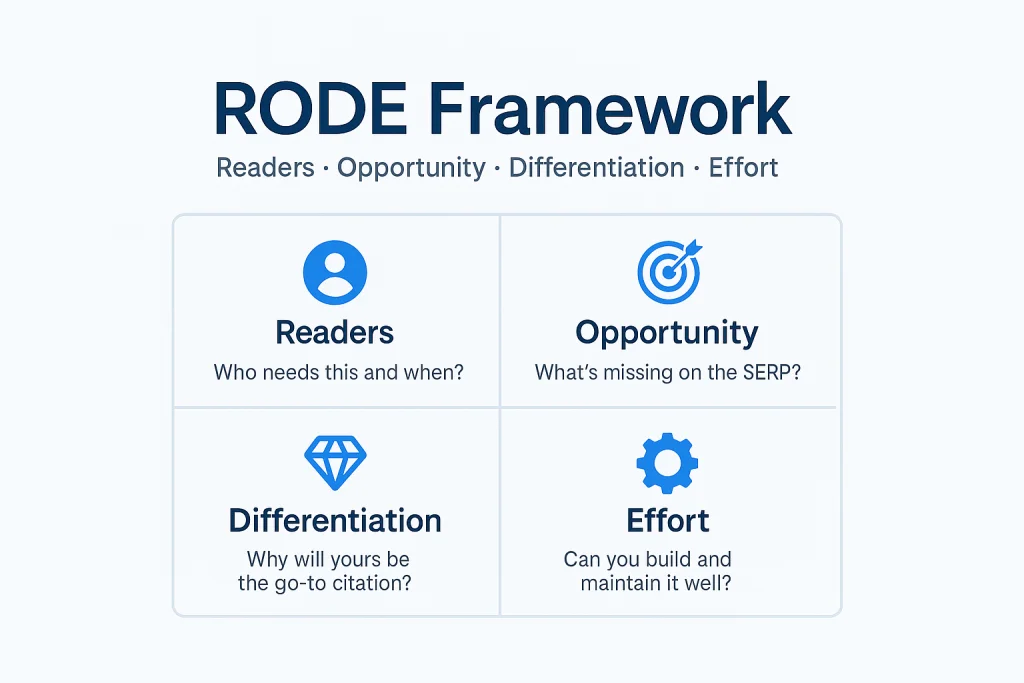
RODE to choose the right asset:
- Readers: Who needs this and at what moment. Bloggers writing list posts, newsrooms on deadline, or new buyers comparing options.
- Opportunity: What is missing on the SERP. Thin stats pages, outdated benchmarks, clunky tools, paywalled references, or regional gaps.
- Differentiation: What makes yours the go to citation. New data, faster tool, better design, clearer definitions, or consistent updates.
- Effort: Can you produce and maintain it well. If it needs monthly updates, do you have the process and people.
Score ideas one to five on each dimension and pick the top one or two.
Core principles to build by:
Keep one clear job per page. A calculator page should not become a four thousand word guide. Put the outcome at the top so visitors can use it in seconds. Show methodology and sources. Make citable parts copy and paste friendly. Add a visible updated date and maintain it. Keep the URL stable and clean. Think like a journalist who is in a rush.
Why Most Linkable Assets Fail and How to Avoid It
Avoid these common mistakes:
- Creating in a vacuum: Do not build something nobody asked for. Validate your idea with audience research first.
- Making me too content: Do not rehash what already exists. Offer a unique angle or a clearly better experience.
- Neglecting design: Do not present great information in a poor package. Invest in a clean, professional, and mobile friendly layout.
- Publishing and praying: Do not assume people will find your content on their own. Dedicate serious time to promotion and outreach. Your job is to put it in front of people who can link.
Pros and Cons of Linkable Assets
Pros:
- High quality, evergreen backlinks
Linkable assets earn natural, editorial links from authoritative sources such as news sites, universities, and industry blogs. These are the most valuable links and can provide benefits for years. - Boosts overall website authority
Links earned by your asset lift the authority of the entire domain. Your other pages, including commercial pages, have a better chance of ranking. - Establishes brand authority and trust
A go to resource positions your brand as a thought leader. Being cited by others builds trust with potential customers and peers. - Drives sustainable, high quality traffic
You attract referral traffic from links and organic traffic from improved rankings. - Excellent long term ROI
A single successful asset can continue to attract links, traffic, and leads for years after publication.
Cons:
- Significant upfront investment
Top tier assets require research, data analysis, content creation, design, and sometimes development. This takes time and money. - Success is not guaranteed
You can invest heavily and still miss if the topic does not resonate, is too niche, or a competitor releases something better. - Requires intensive promotion and outreach
Creating the asset is only half the battle. You must have a robust promotion strategy. - Potential for content decay and maintenance
Data becomes outdated, tools can break, and guides can become irrelevant. You must commit to updates to keep the asset valuable. - High competition and imitation
If your asset succeeds, competitors will notice. Some will try to outdo you or copy your idea. You need to keep innovating.
The Verdict
Creating a true linkable asset requires a significant upfront investment of time, resources, and strategic thinking. It is not a quick tactic. It is a long term strategy.
- Choose them when: You are serious about building sustainable domain authority, establishing your brand as a leader, and committing the resources for creation, promotion, and maintenance.
- Avoid them when: You want quick wins, have a limited budget, or lack the resources to promote the content after it is created.
For those who execute well, the payoff is immense. A single successful asset can redefine your brand’s authority, become your website’s primary source of backlinks, and fuel your organic growth for years. Shift your mindset from simply adding more pages to building foundational pillars of value. Do that, and you will not have to chase links. The links will come to you.
Ready to Build? Your Actionable To Do List
- Analyze competitors’ most linked assets and note what sets them apart.
- Brainstorm your own 10x asset. Identify where you can provide a new insight, a tool, or a truly useful resource.
- Draft your outreach list. Compile at least 20 journalists, bloggers, and curators in your field.
- Set a publishing date and hold yourself to it. Consistency counts.
- Promote, track, and update periodically to keep links coming.
Building great linkable assets is not easy, but it is the kind of leverage SEO professionals rely on. Aim for quality, stay audience focused, and put in the work. The results are compounding, sustainable, and worth the effort.