

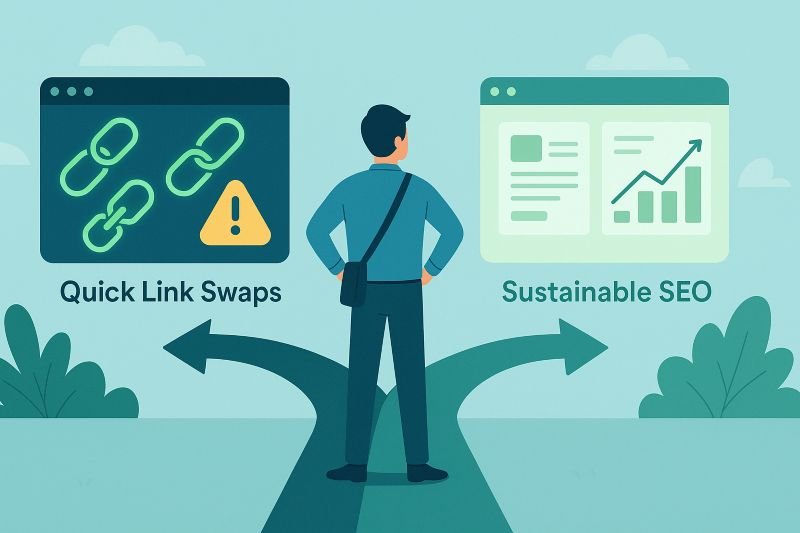
If you work in SEO, your inbox probably looks familiar.
“Hi, I saw your blog. Let’s exchange links.”
“Do you want to join our link exchange group?”
“Add my link here, I’ll link you back from this DR 70 domain.”
At some point you start wondering:
Is link exchange actually good for SEO, or am I quietly building a pattern that Google will not like?
This guide is the honest version most people skip.
We will walk through what link exchange really is, where it sits in Google’s guidelines, how it can help in specific situations, where it clearly crosses the line, and what smarter alternatives look like in 2025.
By the end, you should be able to look at any “let’s swap links” email and know whether to say yes, negotiate something different, or walk away.
What Is Link Exchange In SEO, Really?
Link exchange is simple in theory.
Two sites agree to link to each other. (You link to my page, I link to yours)
In SEO, this is usually called:
- Link exchange
- Reciprocal links or reciprocal linking
But in practice it shows up in different shapes.
Direct 1 to 1 swaps
Two site owners agree: “You add my link in your article, I will add yours in mine.” Sometimes it is framed as “partners,” “friends,” or “resources.”
3 way or 4 way swaps
Site A links to Site B.
Site B links to Site C.
Site C links to Site A.
On the surface it looks less obvious, but when the same people own these sites, it is still a coordinated exchange.
Link exchange groups and communities
Facebook groups, Slack communities, spreadsheets, WhatsApp chats where people post:
“I have DR 45 marketing blog, who wants to swap links?”
Everyone tries to place links for each other in new or existing content.
None of this is inherently “illegal”, the important part is the intent and the pattern.
Is the main goal to help users and add genuinely useful references, or is the main goal to trade link equity and manipulate rankings?
That is what Google cares about.
What Google Actually Says About Link Exchanges
Google has a public spam policy that talks about link schemes and unnatural links.
You do not need to memorize every line, but there is one phrase you should know:
“Excessive link exchanges (‘link to me and I’ll link to you’)” are considered a link scheme.
In other words:
- A few natural reciprocal links are normal
- Systematic, scaled, or manipulative link exchange patterns are not
Think of it this way.
If your site links to a tool you actually use, and that tool links back to your case study because it shows their product in action, that is perfectly reasonable.
If half of your backlink profile is people you swapped with in a Facebook group, that starts to look like a network whose main purpose is to pass PageRank around.
Google does not need to “catch you in the act.” It can look at signals such as:
- Unusual ratio of reciprocal links
- Obvious footprints across the same set of sites
- Links that sit in long “partners” or “friends” pages
- Many links between sites that do not share a clear topical relationship
This is why link exchange SEO feels risky.
A single swap will not explode your rankings, but a pattern of it can quietly drag your site into a lower trust category.
Do Link Exchanges Help SEO Anymore?
I’ve seen sites that got an early boost from aggressive swaps… and then spent months trying to untangle that footprint when traffic dipped.
Short answer: sometimes, a little, with real risk attached.
Longer answer.
Where link exchanges can help
If you are selective, link exchanges can bring some benefits.
- A contextual link from a relevant site can pass authority
- You might get referral traffic if their audience overlaps with yours
- Very small, new sites can get some initial exposure and discovery
If you and another brand genuinely serve the same audience with complementary services, cross linking your most helpful resources can be good for both users and rankings.
Where the limitations kick in
Here is the part people ignore in “link swap” groups.
- Most offers are from sites that chase DR, not quality
- Many of those sites are already in obvious exchange circles
- Their outbound link profile is full of completely random niches
Even if you secure a few links that seem decent, it is easy to drift into:
- Over optimized anchor text
- Dozens of “resources” or “partners” pages
- Too many reciprocal relationships per domain
So yes, link exchanges can still move the needle in very specific, carefully chosen situations.
But as a strategy, “I do link building by swapping links” is weak. The upside is modest, the downside is very real.
It is like using your credit card for everything. Convenient in the short term, risky if you rely on it as your main financial plan.
When Link Exchange Turns Into A Link Scheme
Google uses the word “excessive.” That is vague, which makes people nervous.
The practical way to read it is:
When your main link building motion is trading links, you are in link scheme territory.
Clear red flags include:
Scaled swapping as a system
If most of your new links come from:
- “You link to this URL, I will link to that URL”
- Shared spreadsheets of “who can place what”
- Organized groups where people are required to return favors
it starts to look like a network designed to manipulate rankings.
Off topic exchanges
Your site is about SaaS marketing, yet you are swapping with:
- A casino blog
- A crypto review site
- A generic tech magazine that links to anything
The more off topic the domains, the more obvious the manipulation.
Sitewide and footer links
Exchanging sitewide footer links or blogrolls is almost always a bad idea now. It creates a strong reciprocal footprint for very little user value.
Hidden ownership and PBN like patterns
Three or four sites owned by the same person linking around in circles, especially if those sites mostly exist to publish guest posts and swaps, fall right into what Google calls link schemes.
When your exchange activity looks like this, rankings might not tank overnight. Instead, Google can quietly assign less value to those links, or to your domain overall.
You end up working hard for links that barely count, while carrying extra risk.
How To Use Link Exchange (If You Really Must) With Minimal Risk
Sometimes saying “no link exchanges at all” is not realistic.
You might have a partner integration, a directory of recommended tools, or another brand in your ecosystem where it makes sense to cross link.
If you choose to do it, treat link exchange like a fragile ingredient.
Use it sparingly, and follow some clear rules.
Relevance over everything
Only say yes where:
- The other site clearly serves the same or closely related audience
- Their content is genuinely useful to your readers
- Your content is genuinely useful to theirs
If one of you is stretching to justify the connection, it is probably not worth it.
Contextual, not “partners” pages
Links should sit inside real content that people actually read.
For example:
- A “best tools” guide that explains why your partner is worth using
- A tutorial that naturally uses the other product in a workflow
Avoid pages that are just long lists of logos and anchors.
No hard obligations
Stay away from:
- “We will only link to you if you link back”
- “You must place our link within X days to keep yours”
Healthy collaborations sound more like:
“If the guide fits your content and helps your readers, it would be great if you reference it too.”
Keep it occasional
If link exchange is a rare exception inside a healthy mix of other link types, it is much less of a problem.
If you check your backlinks and realize that swap partners dominate your recent links, it is time to reset.
A Simple Checklist For Evaluating Link Exchange Offers
When a link exchange email lands in your inbox, run it through a quick filter.
You can even score each item from 1 to 3 and total it out of 20.
- Topical fit: Are you in the same niche or a clearly related one, or are they random?
- Real traffic: Does the site get real organic traffic, or only have high DR from historic links?
- Outbound link quality: Are they linking to relevant, decent brands, or to casinos, loans, CBD, “write for us” pages everywhere?
- Placement type: Will your link live inside a well written article, or on a generic “resources” page with dozens of other links?
- Anchor text: Are they pushing for an exact match commercial anchor, or something natural that fits the sentence?
If you feel uncomfortable answering any of these, that is your signal.
A practical test you can use:
“Would I still want this link if there was no swap involved?”
If the answer is no, the link is not worth the risk.
Better Alternatives To Traditional Link Exchange
The good news is that you do not need exchanges to build strong links.
The effort you put into chasing swaps can be redirected into tactics that are safer and more scalable.
Yes, it’s slower. You won’t wake up tomorrow with 20 new links. But the links you do get will still be standing when the next update rolls out.
Contextual guest posting
High quality guest content on relevant sites is still one of the most reliable ways to earn contextual links.
The key is:
- Strong, original content
- Real websites with real audiences
- No obligation to return links
If your guest articles actually help people, editors are usually open to treating you as a recurring contributor rather than a one time link inserter.
Creating linkable assets
Instead of trading links, give people a reason to reference you.
Examples:
- Data studies and industry surveys
- Deep how to guides that fill obvious gaps
- Checklists, frameworks, templates, calculators
These assets attract natural mentions when other writers need a reference, screenshot, or example.
Digital PR and expert commentary
Offer commentary to journalists, bloggers, and newsletter writers in your niche.
If you are early with a useful quote, a statistic, or a case study, you can earn links in:
- Roundup posts
- “Expert tips” articles
- Niche industry reports
These links are usually editorial, non reciprocal, and very high quality.
Co marketing and partnerships
Co hosted webinars, co branded ebooks, podcast guest interviews, joint case studies.
The link is a byproduct, not the product.
That is a much healthier pattern in Google’s eyes.
When you zoom out, traditional link exchange looks small and tactical compared to genuine collaboration and content driven link building.
Realistic Use Cases Where Link Exchange Might Make Sense
There are situations where reciprocal links are natural.
You do not need to panic about these.
Tool integrations
Your product integrates with another tool.
You list them on your “integrations” page, and they list you on theirs.
Users expect this. It helps them discover which tools work together.
Partner directories inside a clear ecosystem
For example, an ecommerce platform that lists vetted design agencies, and those agencies list the platform in their “partners” section.
As long as the directory is curated and not a pay to play link farm, this is standard.
Case studies and success stories
You write a case study on how another tool helped your brand. They link back to your study from their “customer stories” section.
The links exist because there is a real story, not a hidden link deal.
In these cases, the safest approach is to keep the footprint clean.
- Do not force mutual links everywhere
- Avoid over optimized anchors
- Keep your partner pages lean and curated
How To Respond To Link Exchange Emails
Most SEOs receive multiple “let’s exchange links” messages each week.
Having a few pre written responses makes life easier.
1. Polite decline
Hi [Name],
Thanks for reaching out and for thinking of us.
At the moment we are not doing structured link exchanges, as we try to keep our backlink profile as natural as possible.
I appreciate you getting in touch and wish you the best with your site.
Best,
[Your name]
2. Pivot to a content collaboration
Hi [Name],
Thanks for reaching out and sharing your site. Rather than a straight link swap, we usually prefer collaborations that are useful for both audiences, for example:
- guest articles that add something new to our blog, or
- co created content like case studies or guides
If you have any content ideas that would fit [your audience or topic], feel free to share a couple of concepts and we can see if there is a good fit.
Best,
[Your name]
3. Conditional yes for rare, high quality fits
Hi [Name],
Thanks for getting in touch. Your site looks relevant to our audience.
We are open to featuring genuinely useful resources inside existing or new content, as long as they fit the topic and provide value to readers. We also sometimes reference partners from our side when it makes sense contextually.
Please send over the specific URL you would like featured, what topic you see it supporting, and the page on your side where you think our content would fit. If everything lines up, we can explore a collaboration.
Best,
[Your name]
You control the rules. If something feels forced or “too transactional,” you can always walk away.
FAQs About Link Exchange And SEO
Is link exchange good for SEO in 2025?
It can bring some benefit in very selective, relevant cases, but it is not a reliable primary strategy. It is better to treat it as a small, occasional tactic, not the core of your link building.
Is link exchange against Google’s guidelines?
Google warns against excessive link exchange as part of its spam policies. Natural, occasional reciprocal links are normal. Large scale or systematic link swapping is considered a link scheme.
How many reciprocal links are too many?
There is no fixed number. What matters is the pattern. If your backlink profile shows a lot of obvious swaps and circular links, that is risky. Aim for a diverse, mostly editorial profile where reciprocity is the exception.
Are link exchange groups safe?
Most open “link exchange groups” create very visible footprints. They often mix unrelated niches and attract low quality sites. In many cases they do more harm than good in the long term.
What is the difference between link exchange and guest posting?
Link exchange is about trading links between existing pages. Guest posting is about contributing new, original content to another site in return for attribution and relevant links. Guest posts can be part of a healthy strategy when they focus on value, not on exchanging favors.
Can I get a penalty for link exchanges?
If your link profile is heavily built on manipulative exchanges and networks, you increase your chances of a manual action or algorithmic devaluation. That is why it makes sense to keep link exchanges limited and carefully vetted.
What are safer alternatives to link exchange?
Guest posting, digital PR, linkable assets, expert commentary, and co marketing partnerships are all safer, more scalable ways to earn links in 2025.
Final Thoughts: Treat Link Exchange As A Spice, Not The Main Dish
Link exchange SEO lives in a grey area.
Used rarely, in context, between strong and relevant sites, it is just part of the web’s natural linking behavior.
Used as a shortcut or a system, it becomes a clear link scheme that chips away at your site’s long term trust.
Next time a swap email lands in your inbox, don’t just ask ‘Is this a link?’ Ask ‘Would I still be proud of this link in a year?’
If the answer’s no, you already know what to do.
Spend more time creating things people want to link to than trying to trade links you do not fully trust.
That mindset alone will move you away from fragile tactics and closer to sustainable, defensible SEO.