

If you work in SEO long enough, you must have seen or heard that:
“SEO is dead.”
“Links are dead.”
“Everything will be AI.”
Right now, the fear sounds like this:
“Should I still invest in link building if AI is changing how people search? What if, in a few years, classic SEO is basically part of the past?”
It’s a fair question. AI overviews, answer boxes, and chat-style search experiences are changing how people discover information. At the same time, Google is getting more aggressive with spam updates and link scheme crackdowns.
So… where does that leave link building? Is it still worth it? Or are we clinging to something that won’t matter in a few years?
Let’s unpack what’s actually happening and what the future of link building really looks like in an AI-first world.
Why Links Existed in the First Place (And Why That Still Matters)
Link building isn’t an SEO trick that came out of nowhere. It’s built into how search started.
Google’s original PageRank idea was simple: links from one page to another act like votes of confidence. Enough trustworthy votes → the page is probably useful. That basic logic hasn’t changed, even if the algorithm is wildly more complex now.
The twist today is this:
- Google doesn’t just look at how many links you have.
- It looks at who is linking, why, and in what context.
On top of that, Google increasingly talks about E-E-A-T (Experience, Expertise, Authoritativeness, Trustworthiness) as a way to judge quality. Links, mentions, and citations are some of the strongest external signals of that authority.
Even as AI rewrites how results are displayed, search engines still need a way to decide which sources to trust. Links and mentions remain one of the cleanest, hardest-to-fake signals for that.
So no, links won’t vanish. But how they work is shifting.
How AI Is Actually Changing Search (And What That Means for Links)
When people say “AI will kill SEO,” they usually mean:
- AI answers more questions directly in the SERP.
- Fewer people click on organic results.
- Traditional rankings matter less.
Some of this is already happening. AI overviews and rich results can soak up clicks for simple, factual queries. But that doesn’t mean links stop mattering. It means their role is evolving in three big ways.
1. Links as training data and “trust anchors”
AI systems don’t magically know what’s authoritative. They learn from content and patterns on the web.
Well-linked, frequently cited websites are more likely to:
- Be crawled more often
- Be included more deeply in training data
- Be used as examples of “trusted sources”
You might not see a blue link at the top of the page in every SERP anymore, but if your site isn’t part of the trusted universe that models learn from, you risk being invisible in the background too.
2. From single pages to entities and brands
AI shifts focus from “this keyword on this page” to:
- Which entities are associated with this topic?
- Which brands are consistently mentioned in that context?
In that world, link building becomes less about blasting links to a single landing page and more about:
- Being referenced in credible articles
- Appearing on reputable lists and reviews
- Being co-mentioned with known brands and experts
It’s still link building. But it’s link building as brand and entity building.
3. Links as “evidence” in AI answers
Even if users interact with an AI summary instead of scrolling through ten blue links, AI still has to:
- Pull sources
- Cross-check information
- Show where the answer came from
The sites rich in high-quality, contextual links are more likely to be those sources. You might not get the same CTR as a classic #1 organic result, but you won’t even be considered if your site never shows up in that link-based quality graph.
For example, search for “best enterprise CRM for startups”. on Perplexity AI or Google. You will see:
On Preplexity

On Google:
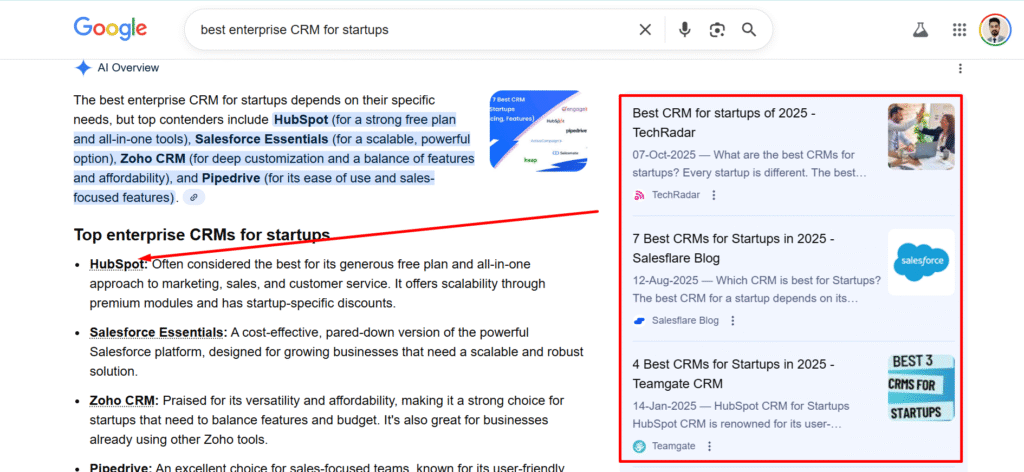
See? The AI didn’t just guess; it pulled data from these three specific URLs because they had high authority.
What’s Not Going to Survive (Old-School Link Building That Will Die)
Let’s be honest: some types of link building absolutely are on borrowed time.
If your current strategy looks like:
- Buying placements on random “write for us” blogs
- Using AI to spin generic guest posts at scale
- Dropping links into irrelevant listicles
- Building networks of sites that exist only to trade links
…then yes, you should be worried.
AI makes it easier for Google to detect patterns in content, sites, and link graphs at scale. Combined with human reviewers and manual actions, low-quality link operations become more exposed, not less.
What’s likely to fade out or get riskier over time:
- Purely metric-driven links (DR/DA only, no real audience)
- Networks of nearly identical blogs with thin, AI-generated content
- Over-templated outreach footprints that scream automation
- Anchor text patterns that don’t match natural behavior
That doesn’t mean every paid collaboration or guest post is doomed. It means the “cheap, fast, rinse-repeat” style of link building is the past. AI is actually accelerating that shift.
So, Does Link Building Still Matter? Yes – But the Game Has Changed
Instead of asking, “Will AI kill link building?”, a better question is:
“What kind of link building is still worth doing in an AI-first world?”
Here’s what’s emerging as future-proof:
1. Links that are tied to real audience value
If a link lives on a page that exists only for SEO, its long-term value is shaky. If it lives on a page that real humans read, share, and bookmark – you’re in safer territory.
In practice, that means focusing on:
- Niche blogs with an actual readership
- Industry publications, associations, and communities
- Topical newsletters and media with loyal subscribers
The more your links appear where your audience genuinely hangs out, the less you’re betting on loopholes.
2. Links that build brand and entity authority
Think beyond “get a backlink” and more in terms of:
- Getting reviewed or compared against competitors
- Being included in best of / tools / resources lists
- Being mentioned by experts, speakers, and creators in your field
Those mentions and links help search engines understand: “This brand is consistently part of this topic.” That’s exactly the kind of signal AI-driven search will lean on.
3. Links supported by strong content and products
If the page you’re promoting:
- Has weak content
- Doesn’t align with user intent
- Doesn’t convert or help anyone
…then every link you build to it is a short-term bandage.
As AI reshapes search, the pages that win aren’t just “optimized.” They’re genuinely useful, with links acting as proof that the wider web agrees.
Where AI Actually Helps Link Builders (Without Replacing Them)
AI might be scary, but it’s also one of the best productivity tools link builders have ever had – if you use it right.
1. Research and prospecting
AI can help you:
- Expand lists of relevant sites based on seed examples
- Spot new niches and angles you hadn’t considered
- Summarize long pages to see if they’re truly relevant
You still make the judgment call, but AI cuts down the manual digging.
2. Drafting, not finalizing, outreach
AI is great for:
- Generating first-draft outreach emails
- Suggesting angle variations for different segments
- Helping rephrase for different tones or regions
Your job is to:
- Add real personalization
- Adjust for culture and nuance
- Remove the “robot shine” that everyone is tired of
In a future where inboxes are full of AI-written pitches, human touches become a competitive advantage.
3. Turning raw expertise into linkable assets
Many brands sit on useful knowledge but struggle to turn it into assets that attract links. AI can help you:
- Outline guides, studies, and frameworks
- Repurpose webinars, podcasts, or internal decks into articles
- Brainstorm unique angles or comparisons
You still need subject-matter expertise and quality control. AI just helps you get that expertise into formats people can link to.
What You Should Stop Worrying About (And What to Worry About Instead)
Here’s the psychological part.
Fears you can dial down
You don’t need to lose sleep over:
- “AI will delete all links from the algorithm.”
- Extremely unlikely. Search engines still need off-site signals of authority.
- “If people use AI chat, organic rankings are worthless.”
- For some queries, click-through will drop. For others (commercial, comparison, deep research), people will still explore sources.
- “AI-generated content means no one can compete.”
- AI makes average content easier, which makes standout content more valuable and link-worthy.
Fears worth taking seriously
These are the right things to worry about:
- Over-reliance on low-quality, scalable link schemes
- A backlink profile that’s 90% random blogs with no real audience
- Outreach processes that are obviously automated and generic
- Publishing forgettable, AI-bland content that nobody wants to reference
Those are real risks in a world where AI + big data make pattern detection easier every year.
How to Future Proof Your Link Building Strategy
If you want a simple, honest roadmap for the next few years, it looks like this.
1. Shift from “link counts” to relationship and relevance
Make a conscious move away from:
“How many links can we get this month?”
…towards:
“Which sites and people actually matter in our space, and how do we show up there?”
That mindset alone changes the quality of your link opportunities.
2. Design campaigns that would still make sense without Google
Ask yourself a brutal but useful question:
“If Google didn’t exist, would this collaboration still be worth it?”
If the answer is no (the audience doesn’t matter, the content is weak, the brand is random), that link is probably not future-proof.
3. Invest in linkable assets with real depth
In an AI-saturated world, fluffy content is easy to produce and easy to ignore. What stands out:
- Original data or small studies
- Niche frameworks and processes
- Detailed industry explainers tailored to real problems
- Market-specific or language-specific resources
Those pieces earn links more naturally, and give your intentional outreach a stronger “reason to link.”
4. Use AI as an assistant, not an autopilot
Set a hard rule internally:
- AI can help with research, ideation, and drafts.
- Humans own strategy, judgment, and quality.
The future of link building belongs to teams that merge human understanding of markets and relationships with AI-powered efficiency, not to those who try to fully automate the whole thing.
So… Will SEO and Link Building Become “Part of the Past”?
Some mechanics will.
The version of SEO that relied on:
- Exact-match anchors everywhere
- Comment spam and directories
- Bulk guest posts on any site that said “yes”
That’s already the past. AI will just bury it faster.
But the core idea of SEO – help people find the right solution through search – doesn’t disappear. It changes shape.
And the core idea of link building – earn visible, public signs of trust from other sites and creators – is still one of the cleanest, strongest signals you can send to any search engine, human or machine.
So yes, you should absolutely still care about link building.
Just not the version that treats the web like a spreadsheet of DR metrics.
The future of link building is:
- More about brand and entity authority than raw link numbers
- More about real audiences, relationships, and relevance
- More about earning mentions than forcing patterns
If you adapt to that, AI doesn’t make your work irrelevant. It makes your good work more valuable and your lazy shortcuts more dangerous.