

You’ve heard the advice a thousand times: get great links and your rankings improve. Then you look at a competitor with fewer obvious links who still outranks you. Annoying. What’s going on?
Welcome to the world where search engines read context, not just counts. When they see your website mentioned online, they ask deeper questions:
“What conversation is this website a part of?”
“Who is this website associated with?”
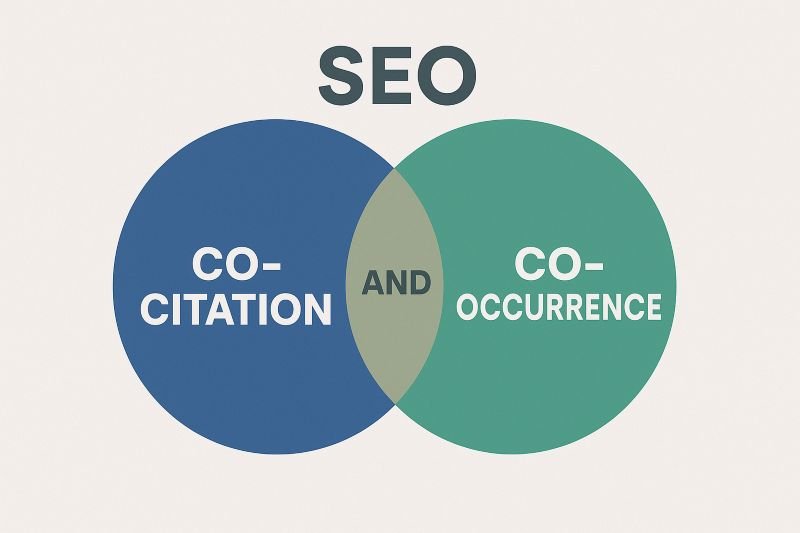
Two ideas sit at the heart of this shift: co-citation and co-occurrence. They explain who sits next to whom in conversations and which ideas travel together across documents. When you understand them, link building stops being a volume game and turns into a proper relevance game.
This guide unpacks both concepts in plain language, shows how they differ, and gives you a practical, step by step way to use them in your day to day work.
Quick definitions
Co-citation
When two or more sources are cited or mentioned together around the same topic, search engines infer a relationship between them. If reputable pages mention Brand A and Brand B side by side in discussions about “email deliverability tools,” the algorithm learns those brands are peers in that topic. This can happen with or without links. Links help, but shared citation in relevant context is the essence.
Crisp Definition: Co-citation is the measure of how often two or more sources (like brands, papers, patents, or authors) are cited or linked together by other, newer documents.
Co-occurrence
When specific words, entities, and phrases repeatedly appear together in documents across the web, the engine learns that those terms are semantically related. If “cold brew coffee,” “immersion brew,” “coarse grind,” and “bloom time” keep co-occurring, the system maps those terms into the same idea neighborhood. Your page earns topical strength when it uses and earns references within the right co-occurring vocabulary.
Crisp Definition: Co-occurrence is the measure of how often two or more items (usually words or terms) appear together within a defined unit of text.
That “defined unit of text” is the key. It could be a…
- Sentence
- Paragraph
- Entire document (like an article or a product review)
- A “window” of a specific number of words (e.g., 5 words before and 5 words after)
The logic is beautifully simple: Things that are talked about together are probably related.
Short version:
- Co-citation is who appears with you.
- Co-occurrence is what appears around you.
They often travel together, but you can optimize for each in different ways.
Why these signals exist at all
Counting links alone was easy to game. Search engines needed richer cues to understand authority and meaning. Co-citation and co-occurrence help:
- Reduce reliance on raw link numbers by examining the company you keep.
- Disambiguate entities that share names. Is “Jaguar” a cat or a car? Context decides.
- Model topics at the phrase and paragraph level, not only at the domain level.
- Reward genuine expertise where the right brands, sources, and terminology cluster naturally.
These signals are not a separate algorithm you flip on. They are part of the broader understanding of entities, topics, and link context. That means you can’t fake them with a handful of tricks. You earn them with consistent topical presence and smart placement.
Co-citation example
For example, a journalist writing a “best tools” roundup for sales outreach. In three separate articles across different sites, the writer mentions:
- Apollo, Lemlist, and Mailshake in the same paragraph.
- Then Apollo again with HubSpot and Mixmax in article about .
- Then Lemlist with Woodpecker and Instantly in a conference recap.
Even if you don’t get a link every time, repeated side-by-side mentions teach the engine that these brands are comparable players. If your brand gets added to that peer set across authoritative sources, you piggyback on the group’s reputation. That’s co-citation doing work for you.
Another example. A food science newsletter compares “King Arthur” and “Bob’s Red Mill” when discussing gluten development. Over time, these two brands become co-cited in baking expertise contexts. A new flour brand that earns thoughtful inclusion in that pairing can ride the same topical currents faster than by chasing random DR 70 links with off-topic pages.
What good co-citation looks like
- Your brand appears near the established names in your category.
- The mention is inside body content that actually compares or evaluates.
- The page’s main topic matches your money topic, not a vague umbrella category.
- The site’s audience overlaps your audience.
What weak co-citation looks like
- Tag clouds, directory lists with hundreds of names, sitewide blogrolls.
- A paragraph that name-drops many brands without clear topical focus.
- A mention on a page about a different theme where your brand is tacked on.
Co-occurrence example
Open five authoritative guides about “mortgage pre-approval.” You’ll see predictable language bands: debt-to-income ratio, credit utilization, hard pull vs soft pull, pre-qualification vs pre-approval, underwriting timeline, loan estimate. These terms form a co-occurrence cloud. If your guide explains pre-approval without brushing against any of those terms, the content feels thin to both humans and machines.
Co-occurrence is not keyword stuffing. It’s concept coverage. You signal real coverage when the right clusters of ideas appear together in sensible proportions. That affects how your page gets categorized, and it strengthens the chance that related queries map to your URL.
Three reliable co-occurrence moves
- Map the must-have entities and distinctions for your topic. If you write about “sourdough starter,” you’ll expect hydration, levain, discard, ambient temperature, feed ratio, and wild yeast.
- Use the query’s neighboring intents. A user searching “refinance closing costs” will often pivot to “points vs credits,” “APR vs interest,” and “break-even calculator.”
- Borrow language from subject matter experts. Interview one pro and your co-occurrence improves naturally.
The difference in one sentence
Co-citation is relational. Co-occurrence is linguistic. You want both.
How search engines likely use these signals
You do not need to reverse engineer every scoring function to benefit. You only need to reason like a researcher.
For co-citation, engines can vectorize document neighborhoods and measure brand adjacency across many pages. The more consistently your brand sits among a known peer set inside the same topic, the stronger the association. This can lift relevance even when your raw link count lags.
For co-occurrence, engines model terms in semantic space. They examine windows of text around entities, weights for headings, emphasis, and anchor text. They look for regularities in which words travel together and which phrases distinguish subtopics. The effect is more accurate topic assignment and richer query matching.
You don’t control the math. You control the inputs: where you get mentioned and which concepts your content actually covers.
Turning theory into a repeatable playbook
Here is a clean, end to end process you can replicate for any topic or market.
1) Define the peer set you want to be co-cited with
Choose 5 to 12 credible names you genuinely sit beside. Be honest. If you’re a new analytics vendor, grouping yourself with Alphabet will look forced. Select a core of realistic competitors and 2 or 3 adjacent leaders.
Collect the pages where these peers appear together in substantive comparisons. Save examples from:
- Independent reviews and analyst notes
- Conference recaps and panel summaries
- Technical how-to articles that weigh tools or approaches
- University or government resources if your industry has them
Your goal is to understand where co-citation happens naturally. That list becomes your placement target list.
2) Build content with strong co-occurrence fundamentals
For your chosen topic, draft a “concept inventory.” This is a simple sheet with three columns:
- Concept: the entity or idea you must touch
- What to explain: the crucial distinction or detail
- Proof point: data, example, or anecdote you can supply
Example for “Email Deliverability Audit”:
- SPF, DKIM, DMARC — explain alignment, show a pass/fail example
- IP reputation and warmup — explain ramp curves, share a week 1 to week 4 trajectory
- Bounce types — hard vs soft, give rate thresholds
- Engagement signals — open rate decay, reply rates, foldering tests
- Seed tests vs real-world sending — limitations, what they do validate
Now your page naturally contains the right co-occurring vocabulary. It reads like a subject matter expert wrote it. No awkward keyword stuffing, just coverage.
3) Create formats that earn co-citation
Certain content types are magnets for side-by-side mentions. Use them.
- Neutral comparisons. Publish honest evaluations of multiple approaches, including yours, with clear tradeoffs and who each option serves best.
- Buyer checklists. Spell out the real decision criteria people use, not marketing fluff. Keep it practical and scannable.
- Benchmarks and studies. Share numbers others will reference. Explain the method, provide a tidy chart, and make the dataset easy to cite.
- Glossaries that actually teac. Go beyond definitions. Add short examples, quick gotchas, and selective outbound links to authoritative sources.
Editors and journalists love citing resources like these because they clarify choices. When they quote you alongside other players, co-citation happens by design.
4) Orchestrate outreach that asks for the right thing
Most outreach asks for a link to a URL. Refine the ask. Your goal is to be placed near the peer set inside the right topical passages.
How to phrase it:
- Suggest a paragraph that compares two or three options, not just a standalone brand mention.
- Offer a short quote that clarifies a concept the article already touches.
- Provide a small table or stat that fits a specific section.
You are not trying to hijack the page. You are helping the editor improve a thought. That earns you the position you need for co-citation strength.
5) Use internal linking to reinforce both signals
Co-citation and co-occurrence start offsite, but internal links carry the baton on your site.
- Create a topic hub that genuinely organizes the cluster.
- From each spoke article, link back using anchors that reflect the subtopic accurately.
- Avoid over-optimized anchors. Mix navigation labels, descriptive phrases, and simple nouns.
Internal links help the engine keep your co-occurring concepts close together and send PageRank to the right nodes.Building a co-citation target list without fancy tools
You can do this in a week with a spreadsheet and focused searching.
- Search “best [category] tools”, “alternatives to [top brand]”, “[category] case study”, “[category] conference recap”, and “[category] vs [category]”.
- For each promising page, record: URL, author, date, peer brands mentioned near each other, and the exact paragraph where they appear.
- Note the site’s editorial stance. Product reviews? Academic? Practitioner run?
- Tag the opportunity as compare, quote, stat, or glossary. That tells you what to pitch.
Even 30 such pages can anchor your next month of outreach. Aim for depth over breadth. Five highly contextual placements beat fifteen “meh” mentions every time.
Writing for co-occurrence without sounding like a robot
Here’s a simple page-level workflow that keeps your language natural and complete.
- Draft the outline using questions your buyer truly asks.
- For each section, list the 3 to 6 terms any expert would expect to see. Do not paste them in. Just keep them visible as you write.
- Write the first pass in your own words.
- On revision, check that you naturally used those terms and handled the distinctions. If not, add one concise sentence or an example that uses the term in context.
Example:
You’re covering “on-page SEO for multilingual sites.” An expert expects hreflang, x-default, canonicalization across language variants, regional targeting vs language targeting, translation memory, locale-specific content. Your revision adds one crisp sentence on how a Spanish page for Mexico should not canonical to Spain when content diverges. Clean, helpful, and it pushes the right co-occurrences into the text.
What about anchor text
Anchor text still matters. But you should think about anchors as micro-co-occurrence windows. The words immediately surrounding a link can carry just as much, or even more, contextual meaning as the anchor text itself.
This changes the optimization strategy. Instead of obsessively forcing an exact-match anchor like “best payroll software” every time, it’s far more powerful to use natural, descriptive anchors.
Instead of forcing “best payroll software” as an anchor every time, prefer natural anchors like “full service payroll and time tracking” inside a sentence that also mentions “multi state compliance” and “941 filings.” The surrounding words signal your true topic better than a narrow anchor can.
Pitfalls that quietly undermine contextual signals
- Getting lost in mega listicles. Targeting massive “Top 100” or “Every Tool Ever” lists dilutes your signal. When 100 brands co-occur in a single article, your name is a speck in a sea of noise. The page rarely compares solutions in detail, so there is little relational signal for search engines to learn from. Instead, focus on being one of 5 or 10, that tight grouping creates a high-intensity contextual co-citation signal.
- Chasing metrics over context. Getting a mention on a high-DR (Domain Rating) site is tempting, but if the content is off-topic, the co-occurrence is wrong. For example, your B2B SaaS tool being mentioned in a personal finance blog just because the metrics look shiny offers no real semantic context to a search engine.
- Publishing thin comparisons. If your comparison articles (e.g., “Tool A vs. Tool B”) never take a position, offer unique data, or provide a clear takeaway, external editors won’t cite them. It only earned when your document is deemed intellectually valuable enough to be a building block for someone else’s argument. If you don’t help the reader decide, you won’t get cited.
- Over-optimizing anchors. Stuffing exact-match anchors across your site makes the language feel unnatural and narrows the semantic window. It can also confuse which page should rank.
- Ignoring dates. While old, foundational pages hold high co-citation value, the active co-occurrence patterns of today are constantly shifting. If the industry conversation has moved from “desktop software” to “AI-powered solutions,” linking to old, authoritative pages that only discuss desktop software misses the current semantic context. You must constantly monitor where the current conversation is taking place to capture emerging co-occurrence signals.
How to retrofit existing content
If you already have a library of posts, you can still adjust for co-occurrence and co-citation without starting from zero.
- Audit five key URLs. For each, list the missing must-have concepts and the missing adjacent intents. Add two to three sentences per gap.
- Add an expert quote to each page. Interview a practitioner for 10 minutes. Drop in two lines. Natural language improves dramatically.
- Secure two contextual placements per URL where your page is cited alongside three peers in a paragraph that makes a real comparison. Even one new paragraph on a credible site can move the needle.
Stop Chasing Just Links, Start Earning Context
The days of link building as a simple numbers game are over. The most powerful authority signals today are earned not through sheer volume, but through contextual relevance.
Co-citation and co-occurrence are not separate algorithms to game; they are the logical consequences of search engines reading, understanding, and mapping the entire web as a semantic conversation.
Your goal is to transition your mindset from:
- How many links can I get? to Who is talking about us, and who are we placed beside?
- How often can I use this keyword? to Which concepts must appear together to prove my expertise?
By prioritizing authoritative co-mentions and ensuring your content covers the right concept clusters, you move beyond merely satisfying the algorithm. You start behaving like a genuine subject matter expert, and that’s the only sustainable way to build long-term topical authority in search.
The conversation is happening. Is your brand consistently sitting at the head of the table, or are you just listed in the footnotes?